Routes / Polder
Pollard willows on the old sea dike
Published
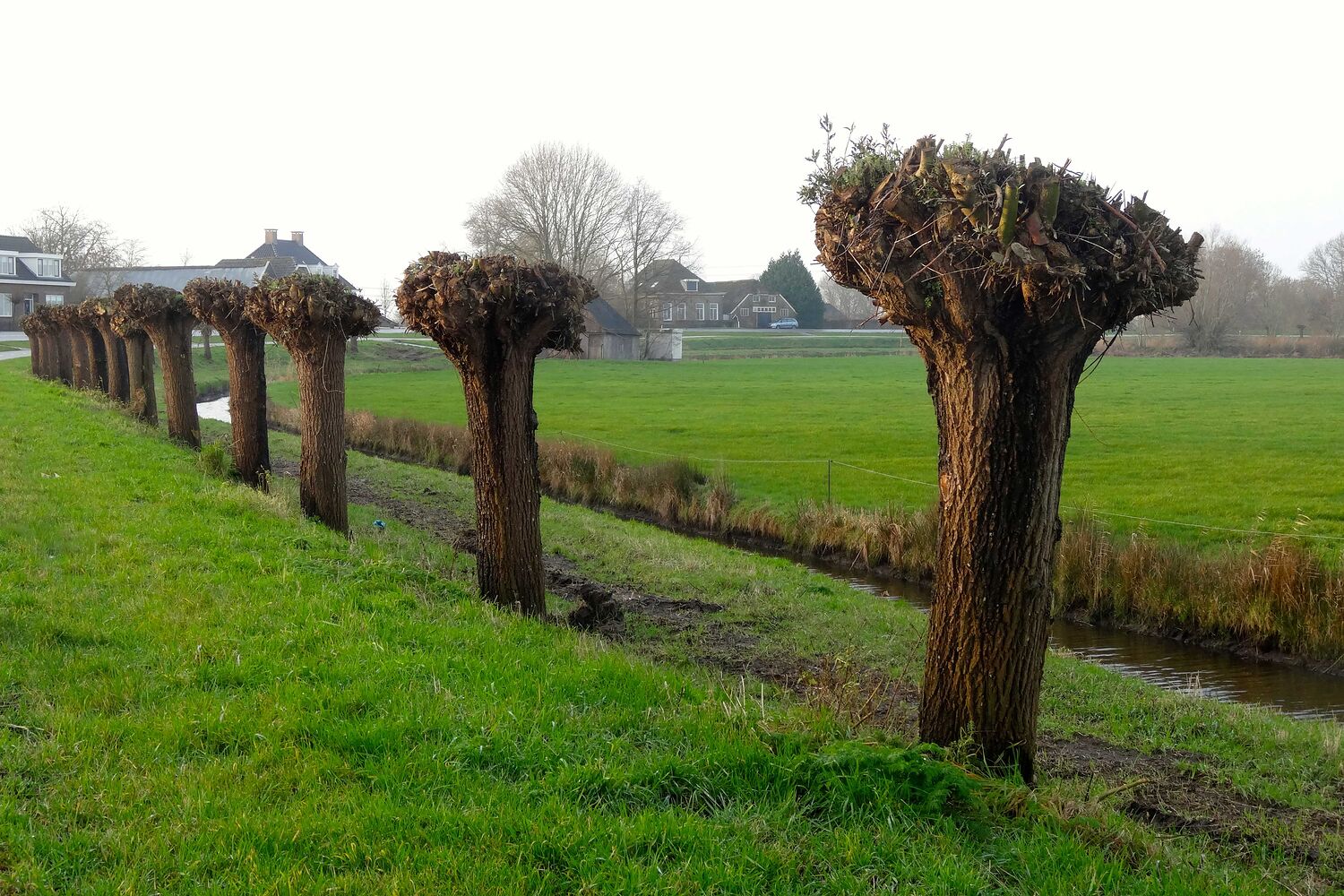
Before the Zuiderzee became a lake, this dike kept the sea out. Now it stands a few kilometres inland with grassland on both sides, and it looks a bit lost. I like it for that.
The best thing on this walk are the knotwilgen, the pollard willows. They are cut back to the trunk every few years, so they grow these thick knobbly heads with a tuft of thin branches on top. In a row along a ditch they look like a line of people waiting for something. In winter, without leaves, they are at their strangest.
It's a short walk. I did it on the last Sunday of November in about two hours, with a long stop to watch a buzzard on a fence post that was watching me back.
Sketch map
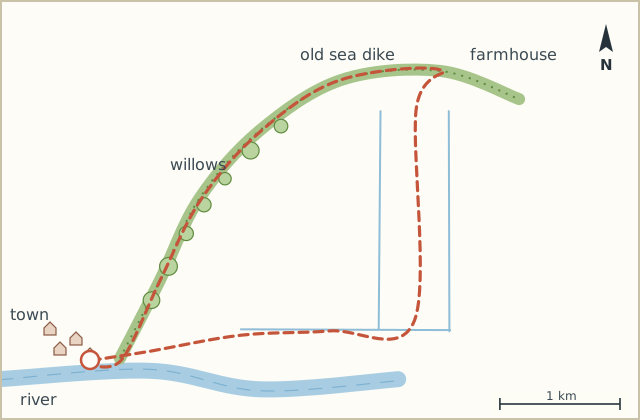
Directions
- From the riverside follow the lane north until the houses stop and the old dike rises up on your right. (0.7 km)
- Climb onto the dike and walk along the top. Willows below you on the left side. (2.3 km)
- Where a farm road crosses the dike, keep straight on along the dike. The willow row from the photo is here. (3.4 km)
- Carry on to the point where the dike swings to the right, with a lone farmhouse at the foot. (4.6 km)
- Go down the farm road on the right, past the farmhouse, between two wide ditches. (5.7 km)
- At the end, turn right along the edge of the field. This bit is muddy; there is a narrow strip of grass along the ditch. (6.5 km)
- Join the cycle path back towards town and follow it to the first houses. (8.3 km)
- Turn left back to the river. (9.0 km)
Notes
Mud
Step 6 is where the boots earn their keep. In a wet winter I'd skip it and walk back along the dike instead (same distance, roughly).
Light
On a clear winter afternoon the sun is low behind the willows from about three o'clock. Worth timing it for.